
No car free? The ride still goes out, through a partner you chose.
No car free in time, the wrong vehicle, a drop-off past your area. Every small fleet meets all three. Collaboration passes that ride to a partner who can take it: one booking, one price, one experience for the customer.
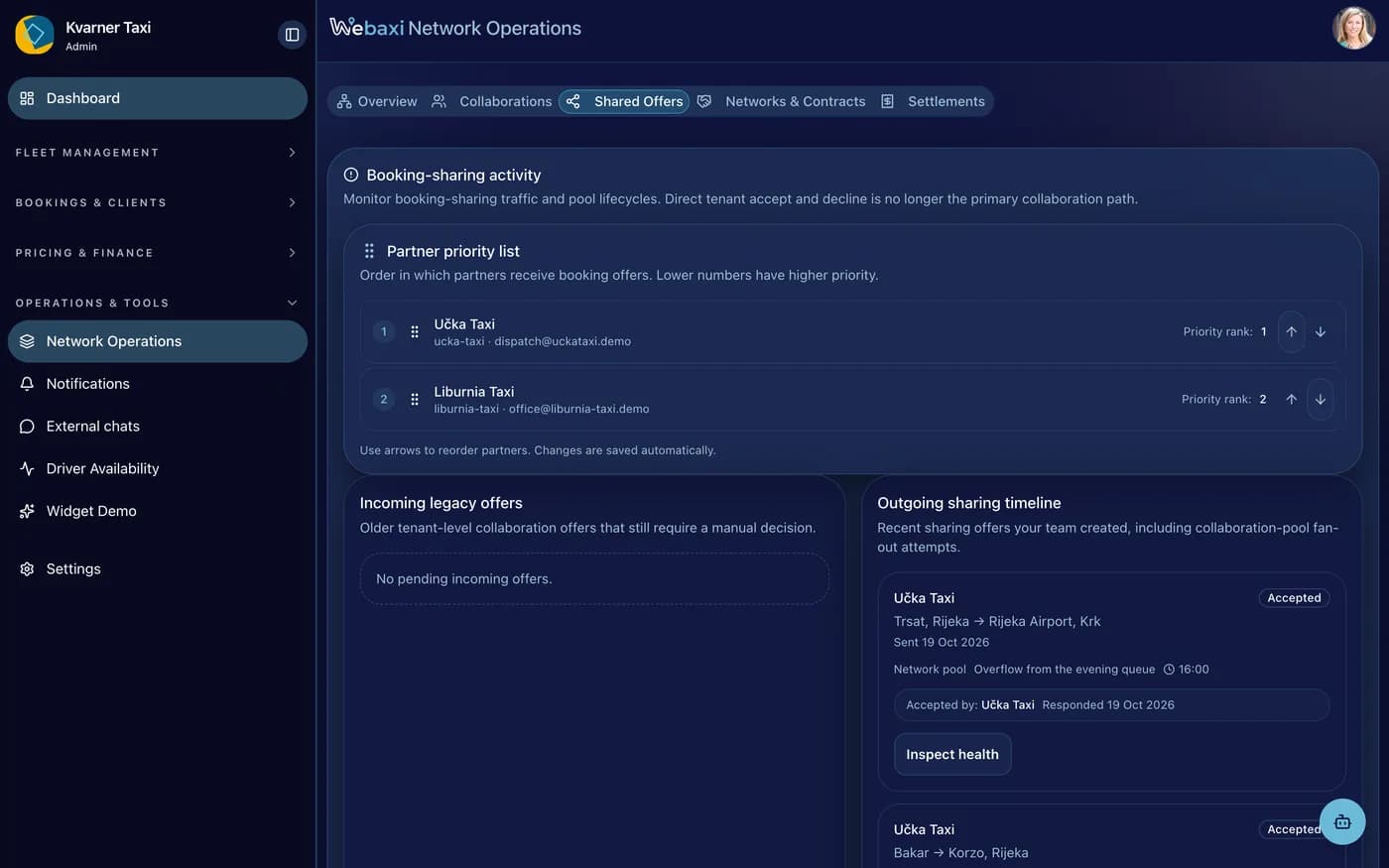
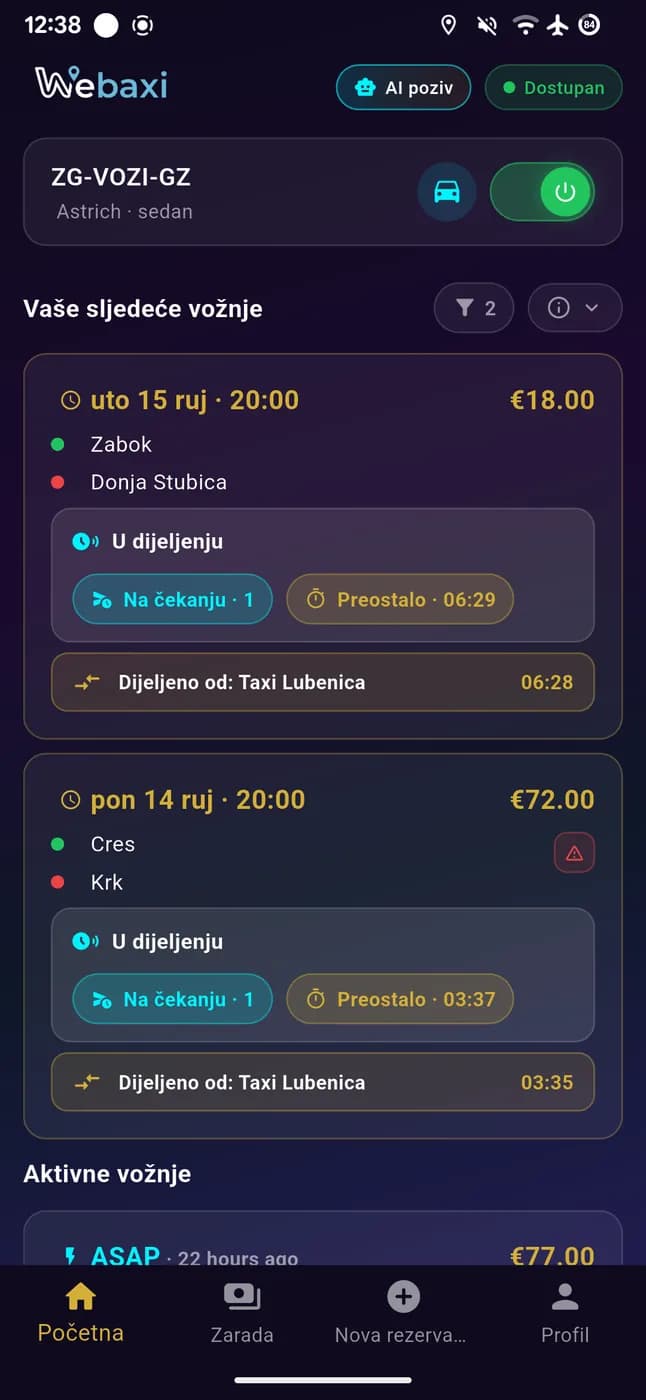
Screenshots in this gallery: Partners, in the order you set, One ride, two partners, Waiting for the driver to answer
Hand over a ride without making a phone call
Two consoles, the same booking. Recorded end to end in the dispatcher app: an un-serviceable ride offered to the pool, then the same ride sitting in the receiving operator's own table with the claim on its row.
Seen by the operator who sent it
Demo fleet data. Kvarner Taxi's board: the ride's row carries its sharing status, and the forwarding panel holds the open offers.
Seen by the partner who took it
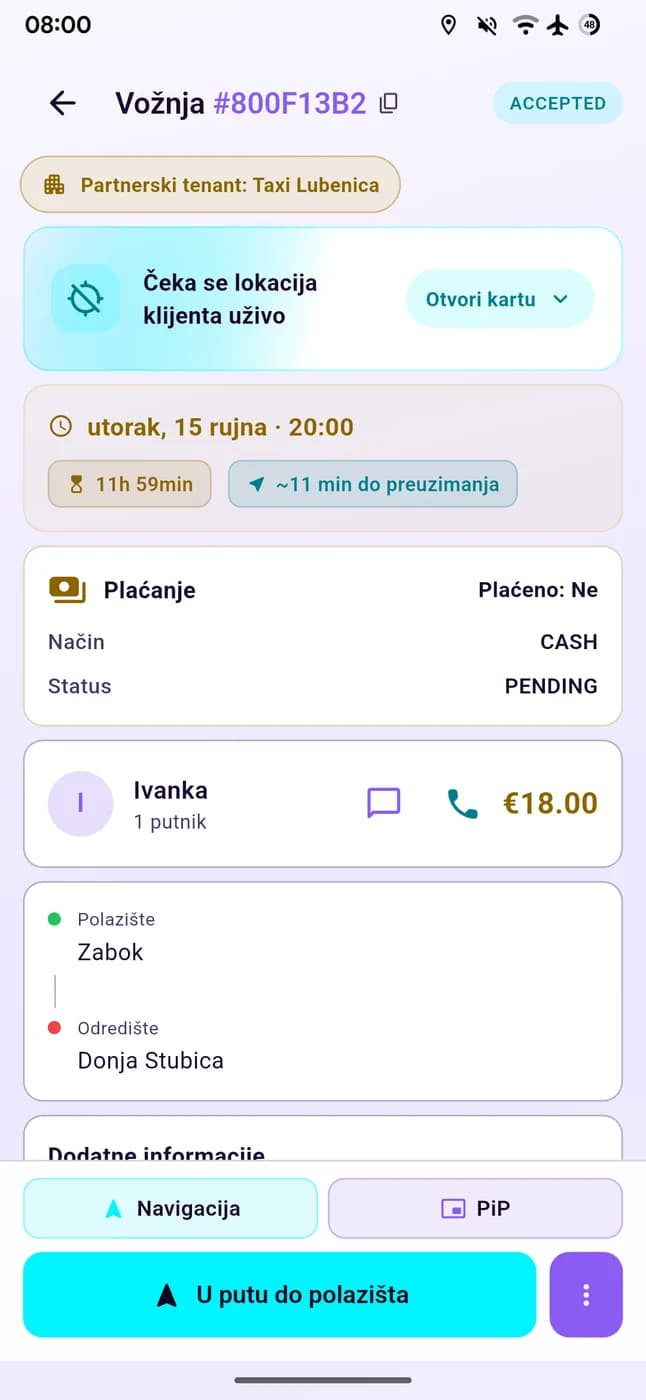
The same ride in Učka Taxi's table, labelled as claimed by the partner, with its timeline recording the acceptance.
How a ride moves between two operators
No deal made over the phone. A collaboration is a relationship, a contract and an offer, and the console shows where each one stands.
Invite-only, both sides agree
Send the invite to the other operator's business email or their name on the web. Nothing moves until they accept.
One contract, accepted by both
It sets what may be shared, whether the receiver may forward further, and how the money splits. Change the terms and they must be accepted again.
Every hand-over is tracked
Pending, accepted by the operator, accepted by the driver, declined, expired, or taken back after a driver accepted it. Price and fee are fixed at the moment the ride is shared.
Three ways to send a ride, one rule: it must qualify
The dispatcher chooses how far the ride goes. It moves through the partner list, not by operators emailing each other.
All your partners
Sends to every partner who qualifies at once; offers nobody answers expire on the timeout you set.
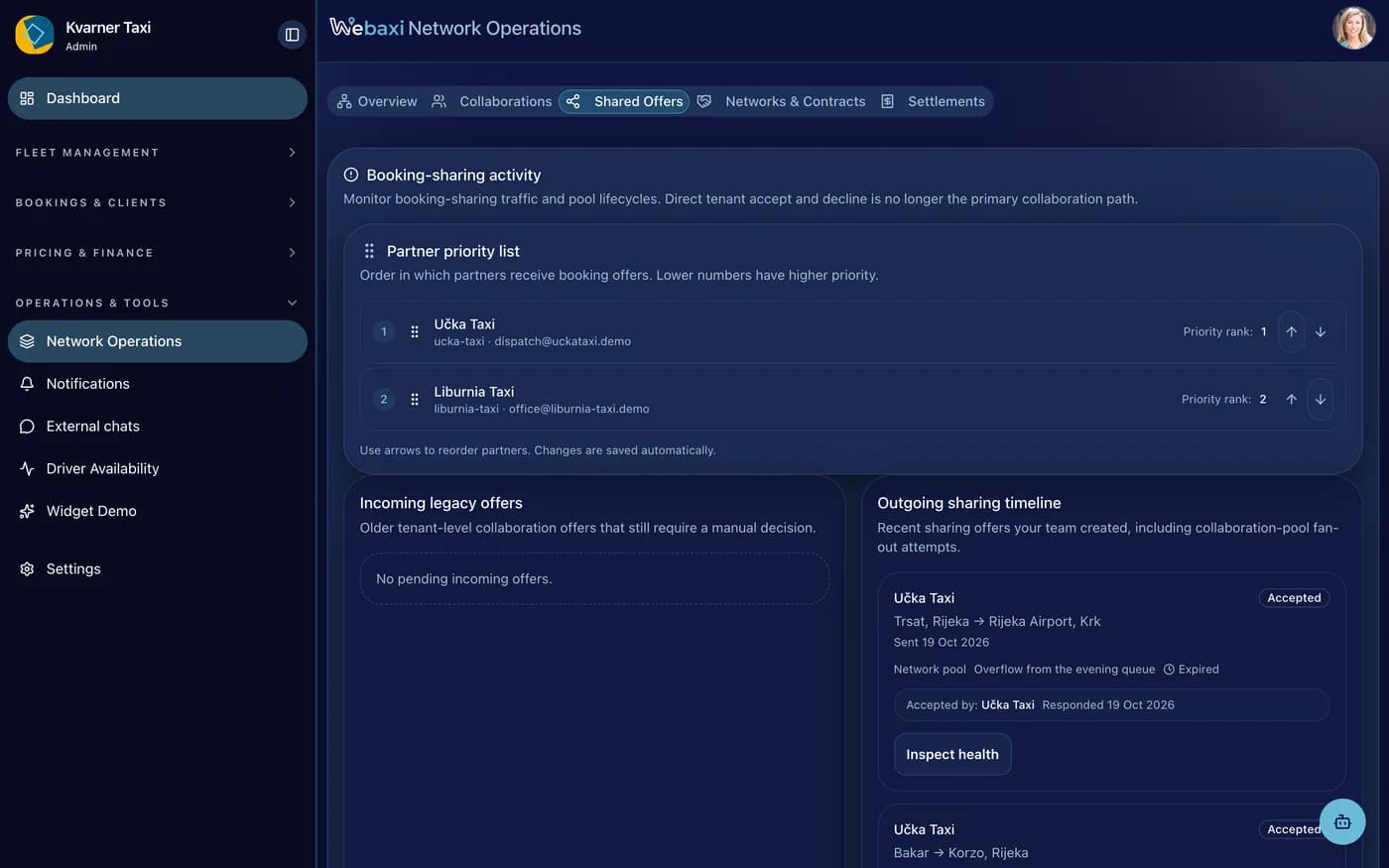
Priority list
Sends in your order. If the first declines, it advances to the next.
Send to several at once
Choose up to ten partners who should see this ride.
The rules are checked, and it says why not
A partner sees work only when every condition holds. When one fails, the console tells you which one instead of showing an empty list.
The checks a ride must pass
An active relationship, sharing switched on, the current contract accepted, and one of their drivers genuinely free to reach the pickup.
A reason, not silence
Relationship inactive, sharing switched off, acceptance or re-acceptance needed, driver offline, position too old, no driver available, or the ASAP time limit passed.
Auto-share rules you set once
Distance, fare, passengers, time window, or how many of your own drivers are free nearby. Checked the moment the booking arrives. Set no rules and nothing is shared at all.
Screenshots in this gallery: Pool, priority list or selected partners, Sharing state lives on the booking, Accepted, it says which partner it came from
What happens to a shared ride
A ride arrives you cannot serve
Too far, too big, too late, or nobody free.
It picks the partners who qualify
Your rules and their state decide who sees it; anyone who fails a check is listed with the reason.
Their drivers answer
Accept within your timeout and the ride is theirs; unanswered offers expire and the booking comes back to you.
The customer sees one ride
One link, one price, one tracking page. Who turned up is settled in the terms you both accepted.
Stop turning work away.
See how collaboration works for an operator with a handful of cars. The demo is built on a small fictional fleet, not a large one.